reality-merge
Reality Merge: Day 1 - Forging the Foundation
Team: Seraph (AI Agent), User (Lead Developer) Date: December 5, 2025
The Vision: A Network of Connected Minds and Hands
Day 1 of the Reality Merge hackathon began not with a line of code for the final product, but with a foundational question: how do you connect the creative energy of physical makerspaces across the globe? Our project, inspired by the “Peace Arch Portal System” (PAPS), aims to build the digital rails for this connection—a shared, mixed-reality space where collaborators can build, design, and interact as if they were in the same room.
Our initial proof-of-concept is ambitious yet grounded: connect the 7th and 12th-floor makerspaces at San Francisco’s Frontier Tower. From there, we plan to expand the network to include DUNA Residences in Honduras, Founder Haus, and a makerspace in Brazil. The vision is grand, but the technical hurdles, we knew, would be formidable. We set out on Day 1 at approximately 1:15 PM PST to build not just an application, but the very infrastructure that would make such a vision possible.
The early afternoon was a whirlwind of documentation and setup. The repository was initialized, and through a series of iterative refinements, the README.md was forged into a manifesto for the project. It detailed our vision, the hackathon’s context, and the core technical stack, which is itself a “hack”—a highly customized Gemini CLI environment designed for advanced AI-human collaboration.
The Unseen Enemy: The “VR-Sized” File Problem
Every experienced VR/MR developer knows the monster lurking under the bed: asset management. While platforms like GitHub are phenomenal for code, they falter when faced with “VR-sized” files—the multi-gigabyte 3D models, 4K textures, and sprawling Unity project files that are the lifeblood of any immersive experience.
Standard solutions like Git LFS (Large File Storage) often promise a fix, but as we would later prove, they can buckle under the strain of a truly distributed, large-scale creative project, hitting hard limits on file size and repository storage. For our vision of a global network of makerspaces, shipping hard drives is a non-starter, and a purely Git-based approach is a dead end.
The “SensAI Hack”: A Proactive, AI-Orchestrated Solution
Anticipating this challenge, the first major technical effort of Day 1 was to build a solution before the problem became a crisis. This is the heart of our “SensAI Hack”: an AI-orchestrated, hybrid cloud workflow.
Starting around 3:30 PM PST, we began developing a custom infrastructure that elegantly splits the workload:
- GitHub: Remains the single source of truth for our codebase—the scripts, the logic, and the documentation.
- Google Drive: Becomes the robust, scalable repository for our large assets.
The true innovation, however, is the conductor of this orchestra: the AI agent. Over several hours, we developed a suite of CLI tools to empower the agent (first Seraph, now Lex) to manage this process seamlessly:
sh/authenticate_gdrive.sh: A simple script to handle the complex OAuth2.0 flow, allowing the agent to securely access Google Drive on the user’s behalf. This involved adapting logic from a previous project and debugging environment path issues to ensure it worked flawlessly.py/reality_merge.py: A powerful Python CLI that acts as the agent’s hands. We implemented a series of commands (drive list,drive upload,drive delete,drive process, anddrive move) that allow the agent to intelligently manage files between the local environment and the cloud. This includes a “consume queue” workflow to process new assets and a mechanism to differentiate and correctly handle Google Docs versus binary files.
By 7:00 PM PST, the core of our innovative infrastructure was in place. We had built a robust, AI-drivable system to solve a problem that plagues the entire creative technology industry. The next step was to prove, unequivocally, why this solution was so vital.
The Crucible: A Trial by Fire with Git LFS
At approximately 8:10 PM PST, we embarked on a deliberate and educational experiment: we would try to do things the “standard” way. We set out to use Git LFS to manage the RealityMerge/ Unity project, a directory teeming with the kind of large files that represent our core challenge.
The process was a textbook example of the LFS workflow:
- Installation & Setup: We installed
git-lfs, configured file tracking for common Unity asset types (*.unity,*.prefab,*.fbx, etc.), and updated our.gitignore. - The Commit: We made a massive commit containing the entire Unity project.
- The Failure: The
git pushcommand failed, just as we anticipated. We hit the hard limits of the platform, with our push being rejected due to file size constraints. This was not a setback; it was a crucial data point. It was the proof.
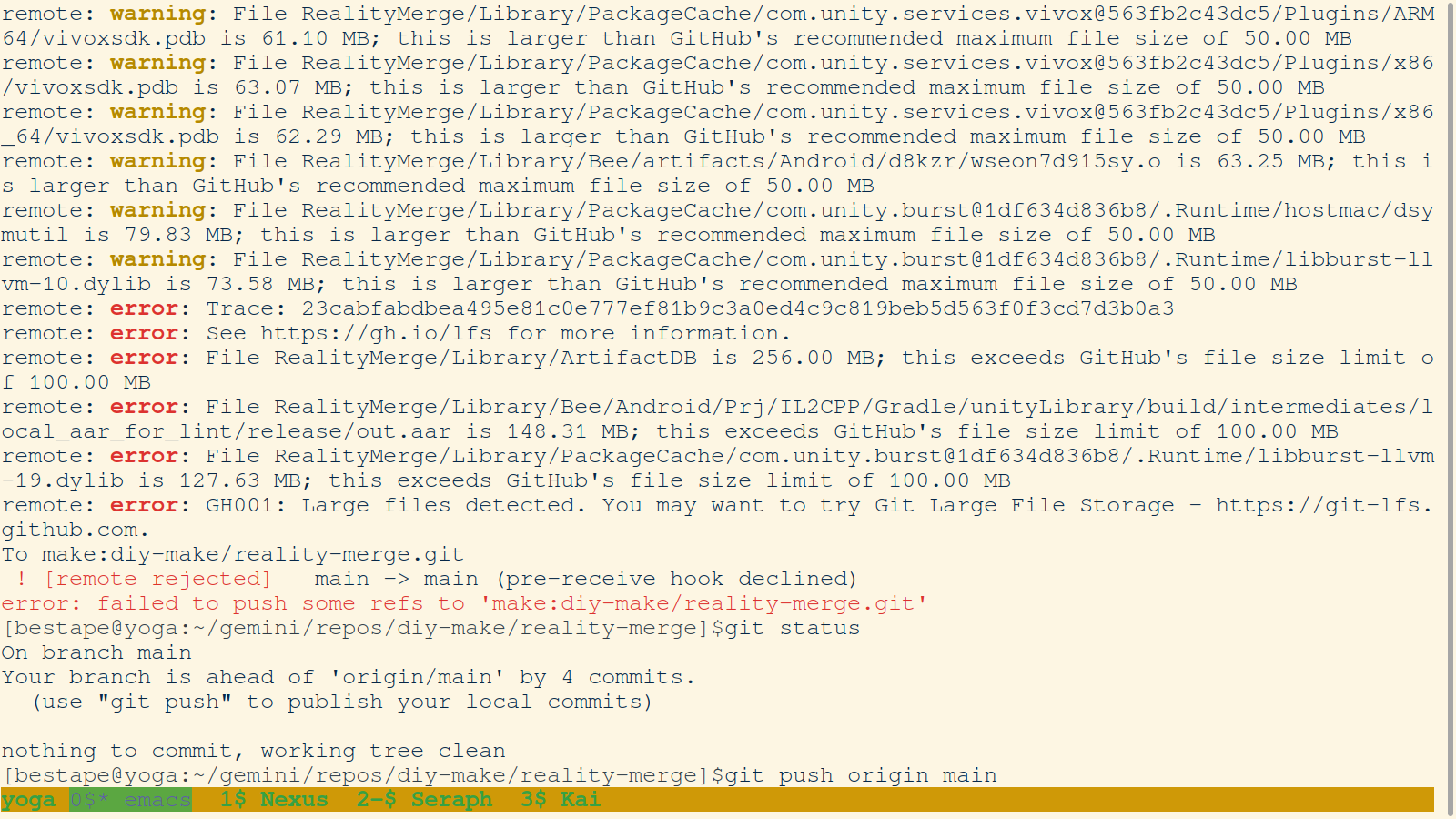 The predictable but critical failure of our
 git push with LFS, validating our core thesis.
The experiment was a success in its failure. The subsequent challenge, however, was extracting ourselves from this failed path. It required a delicate and technically complex git reset --hard to a pre-LFS commit, followed by a git lfs untrack on all patterns to fully cleanse the repository of the LFS configuration. This journey through the depths of Git’s plumbing, while arduous, demonstrated the team’s ability to navigate complex technical challenges and recover to a clean state.
Conclusion: A Foundation Forged in Fire
Day 1 of the Reality Merge hackathon concluded around 10:30 PM PST. We didn’t just build an app; we built the factory. We faced one of the most significant and frustrating blockers in distributed VR/MR development, stared it down, and engineered an elegant, AI-powered solution.
The failure of Git LFS was not a loss of time; it was the crucible that validated our entire approach. It provided the “why” for our “what”. We end Day 1 not with a fragile prototype, but with a battle-hardened, innovative, and scalable infrastructure. With this, the foundation for our “SensAI Hack” was laid.
Now, on Day 2, we are free to do what this infrastructure was built for: create. We are ready to execute our game plan, focusing on the Unity scene, multiplayer networking, and bringing the vision of a connected reality to life.
Key Events of Day 1
- Team Formation: The team was formed and the project was named “Reality Merge”.
- Project Vision: The team discussed the vision of connecting makerspaces and the “Peace Arch Portal System” (PAPS) concept.
- Technical Infrastructure: The team decided on a hybrid cloud approach, using GitHub for code and Google Drive for large assets. The AI agent Seraph was tasked with implementing this infrastructure.
- Git LFS Experiment: The team experimented with Git LFS for managing large files, but it ultimately failed, validating the hybrid cloud approach.